


Take responsibility – for people, materials and the future
Acting responsibly is part of our corporate philosophy.
The basis for this are binding standards, environmental management certified according to ISO 14001:2015 and the OEKO‑TEX® STeP certification of more than two thirds of our production facilities.
Our fields of action

Product policy and raw materials
Our high quality standards in our product policy are firmly anchored in quality management and have been certified by DEKRA according to DIN EN ISO 9001:2015 since 1993.

Employees
Fair working conditions and the protection of employee rights are binding at De Berkel. The basis for this is our Code of Conduct and the OEKO‑TEX® STeP certification of 70% of our production facilities.

Logistics & Planning
The shipping boxes for our products are made from 100% recycled (post-production recyclate) and biodegradable materials. We also rely on structured disposal and recycling solutions, such as processing worn-out items workwear to felt rolls.

Energy management
Reducing CO₂ emissions is an important goal as part of our environmental management. In Poland, 41% of the energy requirement was covered by renewable sources in 2025, including through the operation of photovoltaic systems.
Our seals at a glance
Green button
- The seal is issued by the Federal Ministry for Economic Cooperation and Development.
- The Green Button seal makes sustainably produced textiles visible.
- The Green Button sets binding requirements to ensure that neither people nor nature are harmed.
EcoVadis
As part of our commitment to society, our employees and the environment, each year teamdress Holding conducts a thorough assessment of its sustainability practices by EcoVadis, a global leader in corporate sustainability assessments. The EcoVadis assessment includes 21 sustainability criteria in four core areas: environment, labor and human rights, ethics and sustainable procurement.
In our last evaluation, which was completed in October 2025, we received a silver medal, putting teamdress in the top 15 percent worldwide.
OEKO-TEX® STANDARD 100
Our raw materials, certified according to OEKO-TEX® STANDARD 100, have been independently tested for harmful substances according to extensive scientific criteria.
OEKO-TEX® STeP
Five out of seven of our plants have been certified to OEKO-TEX® STeP following a comprehensive analysis and assessment of chemical management, environmental performance, environmental management, worker health and safety, social responsibility and quality management.
OEKO-TEX® MADE IN GREEN
Our products bearing the OEKO-TEX® MADE IN GREEN label have been extensively tested in accordance with the OEKO-TEX® safety criteria for consumer health and are manufactured in certified and audited production facilities.

TENCEL™
- TENCEL™ Lyocell and Modal fibers are produced with at least 50% less CO2 emissions and water consumption*
- TENCEL™ Lyocell and Modal fibers are obtained from the natural raw material wood
- TENCEL™ Lyocell and Modal fibers support a naturally dry feeling through moisture regulation
TENCEL™ is a trademark of Lenzing AG
*Compared to generic Lyocell and Modal. Results are based on LCA standards (ISO 14040/44) and are available via Higg MSI (version 3.8).

UPV Textile
De Berkel joined the UPV Textiel Foundation at the end of 2022. UPV stands for “Uitgebreide Producenten Verantwoordelijkheid” (Extended Producer Responsibility). Through a joint approach, participants comply with new legislation on the disposal phase of the clothing and textiles they market and sell in our country.
By 2025, 50% of all discarded textiles must be collected and prepared for reuse or recycling, and by 2030 this should be 75%. For this purpose, a common collection, monitoring and reporting system was developed in early 2025.
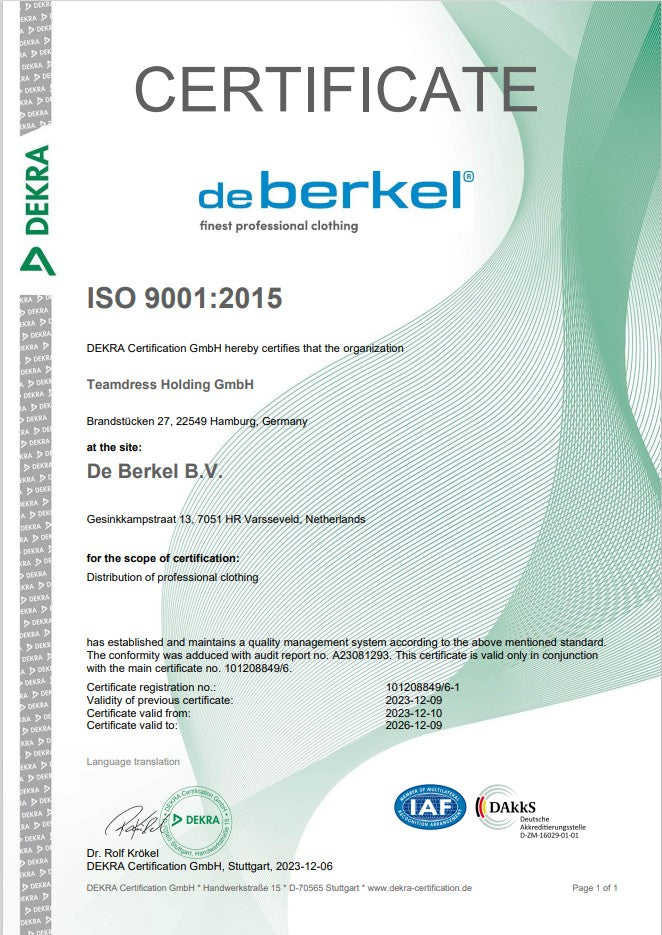
Certifications and standards
Our sustainable measures are regularly certified and checked. In addition to its long-standing ISO 9001:2015 certification, De Berkel achieved ISO 14001 certification in 2025 in order to systematically embedecological responsibility.


